Showing posts with label stew. Show all posts

Friday, 11 March 2011

Courgette/Zucchini Kootu (Zucchini Lentil Stew)


Courgette/Zucchini Kootu (Zucchini Lentil Stew)
Courgette is suppose to belong to the squash family. It is usually hard to come by vegetables from the squash family that I was used to at home. Especially chayote squash (bangalore kathrikai in tamil) as mom used to make kootu with it quite often. Although I do buy courgette every now and then mainly so that I can grate it and include it my wee ones vegetable mix and use it is pasta dishes, I had not really tried any Indian dish with it. This kootu was pretty much the first attempt and the result was good as my husband liked it and my wee one was happy to bite into the courgettes as well. This is sort of how mom used to make kootu...

1-2 courgettes, cubed
1 onion finely chopped
½ teaspoon ginger garlic paste
½ cup mung dal
¼ cup channa dal
Turmeric powder
Salt to taste
Cooking oil

For the masala paste:
1 teaspoon roasted cumin seeds
2 tablespoons grated coconut or dessicated coconut
2 green chillies
2 dry red chillies, roasted
For tadka:
1 teaspoon cumin seeds
1 sprig curry leaves
Asafoetida

Grind together the masala paste adding required amount of water

Heat some oil in a skillet and add cumin seeds. Once it crackles, add curry leaves, asafoetida, ginger garlic paste, onions and courgettes. Cook until courgettes become soft. You could add a bit water so the food does not burn

In the meantime cook the mung dal and channa dal together in a pressure cooker

Add the masala paste, some water and the cooked dals

Bring to boil and simmer for few minutes adding required amount of salt

Garnish with some coriander leaves and serve with rotis or rice


I was preparing this to eat with rotis but if it was for a south Indian meal I may have skipped the onions and the ginger garlic paste. Just reduce the amount of chillies to make this a great toddler/baby food as the veggies and dal are very good for them as well.

Sunday, 18 July 2010

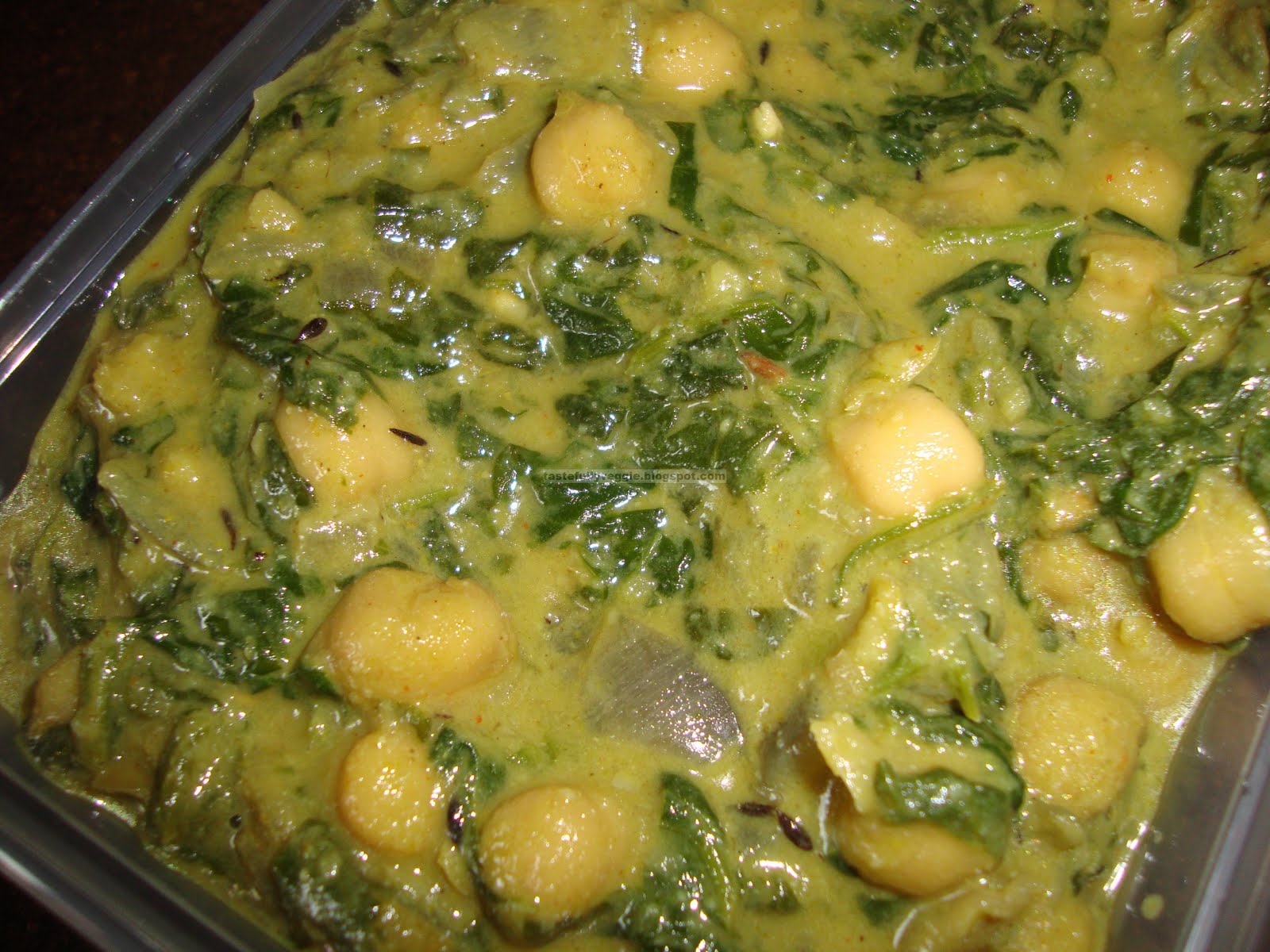
Chickpea Spinach Stew

Chickpea Spinach Stew


Have you heard people mixing up the terms spicy and hot? Indian food immediately rings one bell in non-Indians – spicy. Unfortunately most of them refer to the heat (due to chillies or chilly powder) instead of the wonderful mix of several other spices that go into a dish. In my mind, a dish could be spicy but not hot. One could always increase or decrease the heat and enjoy the wonderful blend of spices. Some recipes somehow make me think it will be ideal for our western friends. It is probably because of their flavours and not having to be hot to be appealing. Also because some of these dishes fit into the kind of style in which their meal is served, like rice with some kind of sauce or naan with a big portion of curry.

This dish is packed with goodness as well. It has chickpeas (garbanzo bean) which are a good source of dietary fibre, essential minerals like phosphorous, calcium, iron, zinc and also goods source of folate and protein. It has spinach, being a green leafy vegetable comes with loads of goodness like chlorophyll, iron, iodine, calcium etc. It is also suppose to be alkaline and thereby help balance your body pH. It also has another important ingredient – coconut. Some shy away from it thinking it is harmful due to its fat content. I have read articles saying that recent studies suggest that coconut has some key components which are infact good for a healthy heart. Always remember, moderation is the key. I have used coconut milk in this dish. I try to keep my ingredients as chemical free as possible so I do not usually buy the tinned coconut milk which has several ‘E’ numbers. I read in a book I bought from a charity shop that I could add boiling water to coconut cream (it does not have any chemicals) to make coconut milk. I tried it as I do not have time (read it lazy) to make it from scratch and then clean it. Worked out great! Okay, that is enough build up, now for the recipe...

1 cup boiled chickpea (that would be about ½-3/4 cup dry chickpea)

1 pack of spinach leaves (about 400g)

1big onion, finely chopped

1 teaspoon ginger garlic paste

1 green chilly finely chopped (increase or decrease based on preference)

1 teaspoon cumin seeds (jeera)

½ teaspoon cumin powder (jeera powder)

½ teaspoon coriander powder (dhania powder)

½ teaspoon chilly powder

¼ teaspoon turmeric powder

½ cup coconut milk (pour half cup boiling water over contents of a 50g packet coconut cream)

Salt to taste

Cooiking oil

In a skillet add teaspoon cooking oil and once hot add the cumin seeds. When they begin to brown, add onions, ginger garlic paste, turmeric powder and chilly.


Once onion is cooked, add the cooked chickpea. I soak overnight and pressure cook until soft and not mushy. If using tinned, drain, rinse and use. Add the spice powders. Add a cup of water and simmer for 10 minutes.


Now add the spinach and once it is almost cooked, add the coconut milk and simmer for few more minutes.


Season with salt, mix and serve.


It goes well with rice and other Indian breads.

If you find it a bit watery, then mash some of the chickpea just to thicken it.

Saturday, 12 June 2010

Vegetable Stew


Vegetable Stew


Vegetable stew is a great dish for many reasons. It can have a variety of veggies thereby providing a lot of the daily nutrition needed. It is a great combination with not just rice but also chapatti, dosa, adai. Most importantly, this recipe is so easy and quick to make.

The first time I wanted to make vegetable stew was using coconut milk. I was pregnant then and hence did not want to use the coconut milk powder (was trying to avoid overly processed food) and sent my husband on a mission to get coconut milk. Unfortunately almost all brands had some additive or the other and hence he didn’t buy any. I then had to adapt the recipe using coconut cream. Much later than that I found how I could make yummy stew without the coconut milk and here is how it is...

2-3 cups of mixed vegetables like carrot, beans, peas, potatoes, cauliflower

2-3 tablespoons coconut powder (or use a packet of coconut cream)

2 green chillies

1 teapsoon mustard seed

¼ teaspoon turmeric powder

1 red onion sliced

Asafoetida (optional)

1 sprig curry leaves (optional)

1 teaspoon each Coriander and Cumin powder (optional)

1 inch ginger piece grated

In a wok or skillet add oil and once hot, add mustard seeds. After it crackles, add green chillies, turmeric powder, onions, asafoetida, curry leaves.


Boil the vegetables separately. Add them to the onions and add about half cup water.


Add coriander and cumin powder if desired.

Add the coconut powder. Also, to achieve a nice consistency, mash few potato pieces so the water thickens.


Allow to boil for 5 minutes or so. Season with salt and serve.


If you find the stew a little thick, add some hot water to it.


Sunday, 18 April 2010

Mung Dal Sambar/Mung Dal Stew


Mung Dal Sambar/ Mung dal stew
Sambar is probably one of the most popular dishes in Southern India, especially Tamil Nadu. I am generally not a big fan of it but my husband loves it. I always make varieties of sambar quite often and ofcourse I do have some favorites. I try to keep the taste unique depending on what the main dish is and that is why I started making mung dal sambar.
Mung is one of the several lentils that we commonly grow and consume in India. Mung bean which is usually green in colour and ovoid in shape is broken and dehusked to yield mung dal. It is quite a versatile dal as it can be used to make a snack by itself and ofcourse a variety of other dishes. Like most dals, it is a good source of protein. Also, this dal is said to cause less wind in the digestive system than other dals.
For this recipe, my main intent was to avoid tamarind as it tends to give a wierd taste that does not go with my main dish which is usually idlis. Here is how I make this nice sambar
¾ cup mung dal
3 tomatoes finely chopped
6 -8 shallot onions or pearl onions
3 green chillies
3 cloves of garlic (optional)
1 tablespoon sambar powder or ½ tablespoon chilly powder
¼ teaspoon turmeric powder
Few pinches asafoetida
Handful of coriander leaves chopped
1 teaspoon mustard seed
1 sprig Curry leaves (optional)
Salt as required
Cooking oil
Cook the dal preferably in a pressure cooker, in which case you will need water an inch above the level of dal. In a sauce pan or wok or kadai heat about 1 tablespoon oil and add the mustard seeds. Once they splutter add curry leaves, turmeric powder and asafoetida. Now add onions (cut them coarsely but if they are small, then just halve them), green chillies and garlic. Once the onions turn soft, add the tomatoes and cook until they become pulpy and come together. Adding few pinches of salt will help speed up the cooking and add water only after it is pulpy. Add the dal and required amount of water based on desired consistency. While it begins to boil add sambar powder or chilly powder and salt. Few minutes later add the coriander leaves and boil for no longer than couple of minutes.